Western Grocer Serving the industry since 1916
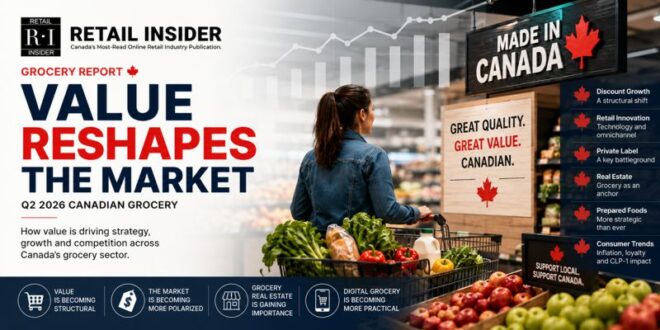
Retail Insider has released Q2 2026 Canadian Grocery: Value Reshapes the Market, a new quarterly industry intelligence report authored by Craig Patterson.
The report is part of Retail Insider Reports, a growing series of sector-level reports tracking major shifts across Canadian retail. Retail Insider Reports are designed to deliver executive-level insights across major retail sectors and can be accessed through the Retail Insider Report Hub.
The Q2 2026 Grocery Retail Report examines the Canadian grocery sector, including supermarkets, discount grocers, specialty food retailers, convenience-oriented food retail, merchandising strategies, store expansion, competition, consumer purchasing trends and broader developments affecting food retail in Canada.
The central finding is that Canadian grocery is not simply moving toward discount. The sector is being reorganized around value. That shift is now shaping store strategy, assortment, technology, loyalty, real estate, product innovation and consumer engagement.
General Themes
- Value is becoming structural: Discount growth is no longer only a response to inflation, as major grocers continue to allocate capital toward value-oriented formats.
- The market is becoming more polarized: Discount banners are gaining traffic and investment, while premium, experiential and culturally specific grocery concepts continue to find opportunity in the right trade areas.
- Full-service grocers face sharper pressure: Traditional banners must defend price perception while still offering fresh food, service, convenience, loyalty, prepared foods and differentiation.
- Private label is a key battleground: Larger grocers are using private label to support value perception, margin management and loyalty, creating pressure for smaller and specialty operators.
- Digital grocery is becoming more practical: AI, delivery partnerships and omnichannel tools are being positioned around meal planning, savings, fulfilment and household budget management.
- Grocery real estate is gaining importance: Grocery is being used to anchor mixed-use projects, reanimate large-format spaces and support necessity-based retail strategies.
- Prepared foods are becoming more strategic: Grocers are using prepared foods to capture meal occasions, compete with foodservice and build higher-margin categories.
- Inflation remains an operating challenge: Food inflation, produce volatility, freight pressure and regional cost differences continue to influence pricing, assortment and promotions.
- GLP-1 drugs are an emerging demand question: The report treats appetite-suppressing medications as a long-term trend to monitor, particularly for snacks, confectionery, alcohol, prepared foods and impulse categories.
Retail Insider Coverage
Retail Insider’s Q2 coverage shows discount grocery becoming one of the clearest growth themes in Canadian food retail. Empire’s FreshCo expansion is cited as a national growth vehicle, with the banner at 161 stores as of June 17, 2026, including 53 in Western Canada and 108 in Ontario. Empire expects to open approximately 15 new FreshCo stores in fiscal 2027 across Western Canada, Ontario and Atlantic Canada. Loblaw’s No Frills network also continued to expand, reaching its 200th store in Ontario during the quarter.
The report also draws from Retail Insider coverage of Loblaw’s ChatGPT-powered grocery integration, Skip’s expanded grocery delivery partnership with Loblaw, Tre’dish’s SproutAI, Nations Experience at Oakville Place, Loblaws Humbertown, Food World Plus in Mississauga and McEwan’s planned arrival at Bayview Village. Together, those stories show grocery being used as a value engine, technology platform, food destination and real estate anchor rather than a static retail category.
Broader Industry Coverage
The broader implication is that discount growth has become a capital allocation strategy. Empire, Loblaw and Metro are not simply adding value formats during an inflationary period. They are reshaping networks around the expectation that value-conscious behaviour will remain part of the Canadian grocery market.
At the same time, the report argues that grocery is not becoming purely discount-driven. Premium and experiential grocery can still succeed when the offer matches the trade area. McEwan at Bayview Village, Nations Experience at Oakville Place and Food World Plus in Mississauga point to a market where food retail can support affluent mixed-use communities, former department store repositioning, culturally specific retail demand and food hall-style destination concepts.
Real estate is one of the more important industry implications. Grocery remains one of the strongest anchors in Canadian retail because it provides frequency and daily-needs relevance. The report also notes the Choice Properties and KingSett transaction involving First Capital, with Choice set to acquire approximately $5.0 billion of high-quality retail assets from First Capital, reinforcing institutional interest in grocery-anchored urban retail.