Western Grocer Serving the industry since 1916
Hot sauce makers thrive amid market oversaturated
By Robin Brunet
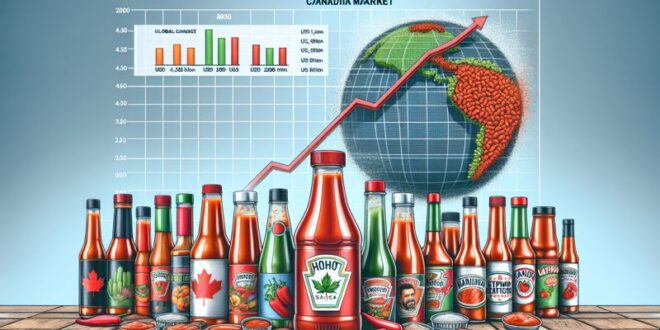
The hot sauce market in Canada is still experiencing robust growth. The global market is expected to reach approximately USD 4.3 billion by 2035, growing at a CAGR of around 6.5% during the forecast period of 2025 to 2035. According to Pristine Market Insights, the total sauces market in Canada will reach just over US$ 4 billion by 2025 and will expand to over US$ 6 billion by 2035. The leading sauce in Canada is ketchup, with a market value of US$ 1,385 million. The second-most-popular sauce is barbecue sauce, recording a total market value of US$ 836 million. Mustard comes in at US$ 533 million.The hot sauce segment of the category, however, is the fastest growing.
Gone are the days when hot sauces used to be a tableside extra. “Now they’re a household staple, found in virtually every kitchen cupboard across Canada,” says Valerie Nolet-Huot, brand manager at I-D Foods Corporation.
This is hugely advantageous to well-established brands such as Tabasco and Nando’s which Nolet-Huot represents. According to Nielson data, Tabasco holds a 6.8 per cent market share in dollar volume while Nandos comes in at 2.9 per cent. Private Label holds the largest share of the market.
Market growth has been closely tied to innovations. Forget just the standard flavours: iconic brands and those from mom-and-pop producers offer tropical blends, smoky notes, and tastes rooted in old food culture.
One example of major producers pushing the heat envelope while retaining all-important flavour is Tabasco, which in Q1 of 2026 will launch its new Scorpion Sauce in Canada via I-D Foods. This is Tabasco’s hottest sauce yet, made with one of the world’s most intense peppers: the Scorpion. The fiery concoction has a Scoville rating up to ten times hotter than Tabasco Original Red, but the small batch offering also features guava and pineapple.
As for Nando’s, earlier in 2025 it unveiled its new Peri-Wing Sauce in three skews: Garlic, Buffalo, and Spicy Brown Sugar.
Cholula, which was recently purchased by McCormick and holds a 4.8 per cent market share, has also shown growth with new launches such as jalapeno poblano hot sauce.
As far as Nolet-Huot is concerned, these new items reflect the seemingly indestructible thirst consumers have for the hot sauce category. “They are keen on trying anything different, and that includes delivery systems such as Tabasco’s squeeze line of bottles, the latest addition of which is Salsa Picante, ideal for aTex-Mex dishes like tacos, burritos, and guacamole,” she says, adding that retailers will have a great opportunity to show off new and established flavours during National Hot Sauce Day on January 22.
Hot sauce as a consumer staple has led to a proliferation of niche brands, with traceability factoring into consumer purchases. In this regard, companies such as Stoke the Fire Hot Sauce, which operates out of a seven-acre farm in B.C.’s Similkameen Valley, have risen to prominence. “We grow 60 varieties of chilli and produce about 10,000 pounds of material annually, plus we have our own fully automated bottling facility,” says co-owner Sarah Harper.
Co-owner Stu Smith adds that their dedication to sustainability along with their seed-to-bottle delivery has resulted in Stoke the Fire Hot Sauce products (the latest of which includes Bear Spray, Life’s a Peach, and Garlic Jalapeno) being available in over 200 stores in Western Canada, with a presence in Ontario and Quebec, in addition to European on-line sales.
In a similar vein, Heartbeat Hot Sauce Co. of Thunder Bay, Ontario uses chilli from two different farms in that province, “and the fact we’re very flavour-focused has kept people coming back and grown our online popularity in Europe, Australia, Asia, and even the Middle East,” says saucier/co-owner Al Bourbouhakis.
Heartbeat sauces have become so popular they have been featured on the YouTube channel hit ‘Hot Ones’, and Bourbouhakis observes that “We were established in 2016 just when the hot sauce category was exploding. Today, many good and creative hot sauce producers fade away quickly due to saturation, so we feel fortunate that we’re still in expansion mode, with Western Canada being a strong growth market.”
Consumer demand aside, an oversaturated market can be a problem for grocers wanting to create effective hot sauce skews, and on that score, Andrew Betteridge, owner/operator of Lucifer’s House of Heat in downtown Vancouver, has advice.
Lucifer’s House of Heat has no less than 300 different varieties of hot sauce in its storefront. “And that would be my first tip to grocers,” says Betteridge, who is also a hot sauce distributor and works with retailers such as IGA. “I used to have 1,000 varieties in my storefront. That was too much. Keep it simple.”
While praising the creativity of mom and pop hot sauce makers, Betteridge says, “Pay attention to expiry dates. Some of the niche brands last for only six months.”
Betteridge advises not to underestimate the marketing power of a sauce having been featured on ‘Hot Ones’: “That is a huge draw for consumers.”
But Betteridge says by far and away the most effective in-store merchandising strategy for hot sauces is sampling. “I always do it, and I urge grocers to do the same. Without it, my sales would be way less. Not only does it attract customers, it compels customers to bring their friends too, and I suppose the ‘dare’ factor of trying to see who can withstand the most heat has something to do with the lure.”
It’s unclear whether the oversaturated hot sauce market will eventually even out or lead to a radical downsizing of product popularity, but the latter seems unlikely now that hot sauces are a pantry staple. If grocers select between established brands and locally made offerings – and set up sampling booths – they will be successful in playing with fire.
-30-